Your selected day · Barua Bari Gaon
2026-11-01 · local time
- Sunrise
- 1 Nov, 05:31 am
- Rahu Kaal
- 1 Nov, 03:17 pm – 1 Nov, 04:40 pm
- Krishna Saptami · tithi interval
- 31 Oct, 04:58 pm – 1 Nov, 02:52 pm
- Krishna Ashtami · tithi interval
- 1 Nov, 02:52 pm – 2 Nov, 01:11 pm
Fourth Navadurga · Maa Kushmanda worship
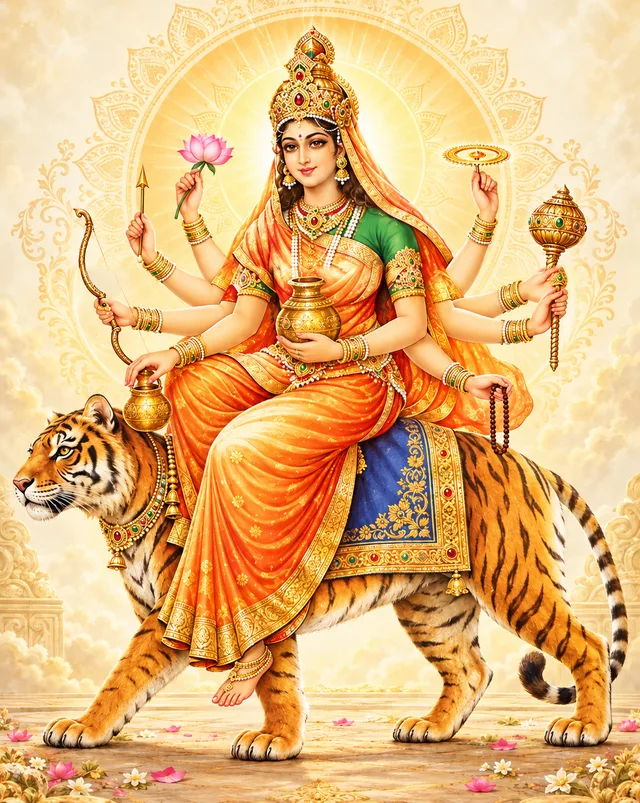
Kushmanda is remembered as the radiant mother whose smile brings forth the brahmanda, the cosmic egg. Her eight-armed form unites creation, prayer and protection. The story gives light a devotional meaning: the capacity to nurture life and meet the day with hope.
Prepare your puja
Prepare fresh flowers, clean water and seasonal fruit or another fresh household offering. Kumkum, incense and a lamp may accompany the prayer according to family custom. Choose a simple arrangement that can be prepared and shared with care.
Simple home puja vidhi
Read more · step-by-step home worship
- Prepare the image and offerings
Clean the prayer space and place Maa Kushmanda’s image where it can be seen comfortably. Arrange the flowers, water and bhog before lighting the lamp.
- Remember her radiant form
Begin with your familiar opening prayer. Reflect on the smile and the eight-armed image, recalling the creative power described in her story.
- Offer and recite
Offer flowers and water and recite the name mantra below. Continue with Durga Chalisa, a familiar Devi hymn or the Saptashati reading used in your home.
- Share the concluding prayer
Offer bhog, complete aarti and share prasad. Include a prayer for the wellbeing of the household and for those who need care.
Read more · Eight arms and the day’s colour
The eight-armed form is also called Ashtabhuja. Its vessels, lotus, rosary and weapons bring nourishment, prayer and protection into one image. Yellow appears in some published Navratri colour sequences, but the annual day-colour list varies; it is not a permanent fourth-day requirement.
Questions about this observance
Does worship promise a cure or prosperity?
Devotees pray for health, wellbeing and abundance. These are devotional hopes, not a medical or financial guarantee.
Must Kushmanda worship be on Chaturthi at sunrise?
The fourth form identifies a place in the devotional sequence. A lunar tithi can repeat or pass between sunrises, so the sequence number should not be used as an independent tithi calculation.
Kushmanda and the image of creation
The fourth Navadurga form is remembered as the radiant mother whose smile gives rise to the brahmanda, the cosmic egg. The story gives darkness and light a devotional meaning: creation begins through her luminous presence. Worshippers turn to her with prayers for vitality, wellbeing, hope and the strength to nurture life.
Kushmanda is remembered through the image of the brahmanda, the cosmic egg. Devotional accounts describe creation arising from her smile. Her radiant form is fourth in the familiar Navadurga sequence and is also known as Ashtabhuja, the eight-armed Goddess.
The eight hands carry a water vessel, bow, arrow, lotus, nectar vessel, rosary, mace and discus in a common representation. Her luminous halo expresses the radiance of creation. The powerful feline mount represents courage, while the gentle smile brings warmth to the armed form.
Dhyana · contemplation
Let your attention rest on the gentle smile and the light around the figure. Think of something that begins quietly and grows through care: a seed, a skill or an act of generosity.
A guided reflection by PanchangSaathi.
Japa · name mantra
ॐ देवी कूष्माण्डायै नमः॥
Oṃ Devī Kūṣmāṇḍāyai Namaḥ.
Salutations to Goddess Kushmanda.
Recite at a comfortable pace, following your family’s practice.
Clothes, colours & flowers
Navratri colour sequences vary with the year, region and local custom. Wear the colour followed by your family or community, or choose clean, comfortable clothes for home worship. A published day-colour list is not a fixed colour rule for a Devi form.
Read more · planning your Navratri prayer
When should I begin?
For a daily reading, choose a quiet time you can return to. If you perform a timed ceremony, open the local festival timings using the date and place you selected.
How much should I recite?
Start with the name mantra and a familiar passage. A longer recitation can be divided into comfortable sessions. There is no compulsory repetition count in this household reading guide.
What can the whole family do?
One person can read aloud, another can prepare the offering, and others can listen or join the name prayer. Finish by sharing prasad and a prayer for everyone’s wellbeing.
Where can I read further?
Open the linked Saptashati collection for its thirteen chapters and companion stotras, or move to the next Navadurga reading below.
Carry the meaning into your day
Bring one useful thing into being today. Prepare a shared meal, start a small piece of work or make time to encourage someone. During prayer, remember the effort and care that creation asks of us. This is an invitation to reflect on the imagery, without treating worship as a promise of wealth or achievement.
Continue your Navratri reading
Reading reference
Traditional name invocation; original explanations and guided reflections by PanchangSaathi. Image credit appears with the illustration. Traditional text and iconography reference.